Rent Calculator: How Much Rent You Can Actually Afford
A rent calculator should tell you more than "spend 30% of your paycheck." That old rule of thumb ignores two things that decide whether rent actually fits: the debt you already carry, and the fact that your take-home pay is far smaller than the gross number the 30% rule uses. On a $60,000 salary, 30% of gross is $1,500 a month — but add a $400 car payment and that same rent quietly pushes your fixed costs past what any lender would call safe.
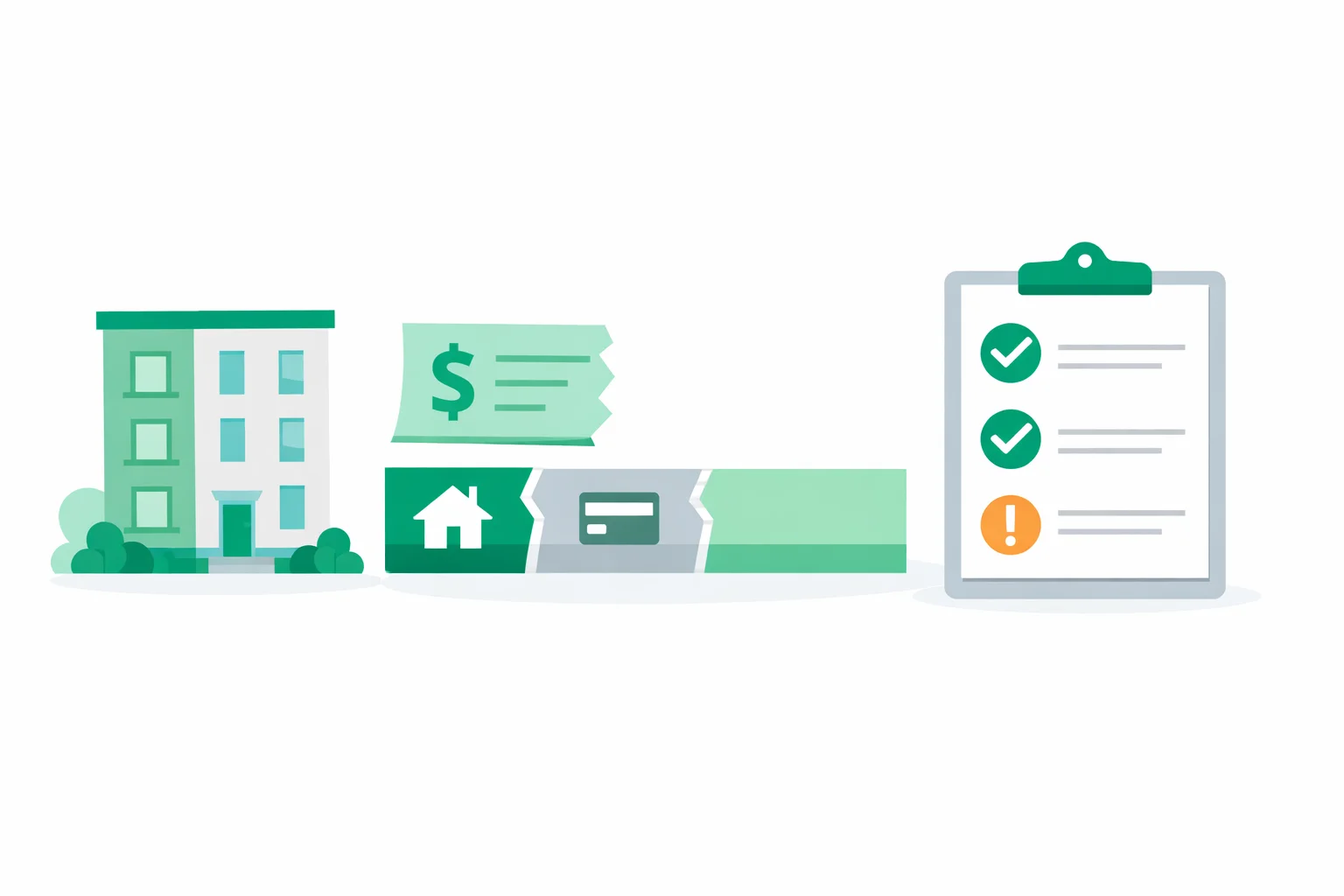
The 30% Rule Is a Starting Point, Not an Answer
The 30% rule dates back to 1969 housing policy, when the government defined a "cost-burdened" renter as anyone spending more than a quarter of income on housing — later bumped to 30%. It stuck because it's easy: take gross monthly income, multiply by 0.30, done. On $5,000 a month, that's $1,500 in rent.
But a single flat percentage can't know whether you have a car payment, whether you live in a state with 9% income tax, or whether your rent includes utilities. Two people earning the identical $60,000 can afford wildly different rent. The rule is a floor to start from — not the answer. According to HUD's own housing-cost research, tens of millions of renters already spend well past 30% — so treating it as a hard ceiling misses how most budgets really look.
Gross Income vs. Take-Home: The Gap That Sinks Budgets
Here's the trap. The 30% rule uses gross income, but you pay rent out of netpay. On a $60,000 salary, federal tax, Social Security, Medicare, and a typical state tax leave you with roughly $3,800 a month. So a "30% of gross" rent of $1,500 is actually eating 39% of the money that lands in your account.
That difference is why so many renters feel broke at a rent the calculator called affordable. If your paycheck already feels tight, budget off take-home instead: aim for rent at or under 30% of net, which usually lands you near 25% of gross. The calculator above uses gross so it matches how landlords screen you — but the conservative tier is there precisely to pull you back toward a net-pay-safe number.
How Landlords Decide: The 3× Income Test
Affordability isn't only your call — the landlord has to approve you. The near-universal screen is the 3× rent rule: your gross monthly income must be at least three times the rent. A $1,500 apartment demands $4,500 a month in income, or $54,000 a year. Fall short and the application gets denied regardless of how careful your personal budget is.
Expensive metros go stricter. Many New York landlords use the 40× rule— annual income of at least 40 times the monthly rent — which is mathematically the same as 30% of gross. If you can't clear the threshold, landlords will usually accept a guarantor earning 80×, a few months of prepaid rent, or proof of savings covering 6-12 months. The calculator's "income landlords want" box shows the 3× figure for whatever rent you test, so you know before you apply.
Your Debt Quietly Shrinks Your Rent Budget
This is the line the 30% rule completely ignores, and it's the one that trips people up. Lenders and better landlords look at a back-end ratio: rent plus all monthly debt payments should stay under about 36% of gross income. On $5,000 a month, that caps rent-plus-debt at $1,800.
Carry $500 in car and student loan payments and your rent room drops from the $1,500 the 30% rule promised to $1,300. The math is blunt: roughly every $100 of monthly debt knocks $100 off your affordable rent. That's why the calculator asks for your debts up front — it computes this debt-safe ceiling and flags when your slider pushes past it. If you're weighing whether to keep renting or buy, that same debt load matters even more; our rent vs buy calculator shows how the numbers shift over the long haul.
$75,000 Salary, $450 in Debt: What Actually Fits
Let's run a real one. Maya earns $75,000 a year — $6,250 a month gross. She has a $300 car payment and a $150 student loan payment, so $450 in monthly debt. Here's how the three constraints stack up:
- 30% rule: 0.30 × $6,250 = $1,875 in rent.
- Landlord 3× test: $6,250 ÷ 3 = $2,083maximum rent she'd be approved for.
- Debt-safe (36% back-end): (0.36 × $6,250) − $450 = $2,250 − $450 = $1,800.
The binding number is the lowest of the three: $1,800. Maya could be approved for up to $2,083, and the 30% rule says $1,875, but her debt pulls the truly safe ceiling to $1,800. At that rent she's left with $6,250 − $1,800 − $450 = $4,000 a month for taxes, savings, and everything else. If she wanted a cushion, the conservative 25% tier ($1,563) leaves her $4,237 and far more breathing room.
Rent Budgets by Income (Reference Table)
Use this as a quick gut check. "30% rent" is the classic rule; "Debt-safe rent" assumes a moderate $350 in monthly debt and the 36% back-end cap. Your real number sits between them depending on your debt.
| Annual income | Gross / month | 30% rent | Debt-safe rent* |
|---|---|---|---|
| $40,000 | $3,333 | $1,000 | $850 |
| $50,000 | $4,167 | $1,250 | $1,150 |
| $60,000 | $5,000 | $1,500 | $1,450 |
| $75,000 | $6,250 | $1,875 | $1,900 |
| $100,000 | $8,333 | $2,500 | $2,650 |
*Debt-safe rent = (36% of gross) − $350 assumed monthly debt. Above about $75,000, the 30% rule becomes the tighter limit, so the two columns cross.
What Rent Doesn't Include
The rent number on the listing isn't your housing cost — it's the opening bid. Budget for these on top:
- Utilities: $150-$300 a month on a mid-size apartment for electric, gas, water, internet, and trash. That alone can turn a 30%-of-gross rent into 36% all-in.
- Renter's insurance: $15-$25 a month, and most leases now require it.
- Upfront cash: first month, last month, and a security deposit can mean handing over 3× the rent — $4,500 on a $1,500 apartment — before you get the keys. Move in mid-month and that first month is usually a prorated rent amount, not the full figure.
- Parking and pet rent: $50-$300 a month combined in many buildings, charged separately from base rent.
The practical takeaway: if your target rent already sits at 30% of gross, your true monthly housing cost is closer to 35-38%. Leave room.
Choose Your Tier: Conservative, Balanced, or Stretch
The tier table in the calculator isn't decoration — it's a decision framework. Pick based on your situation, not a blanket rule:
- Conservative (25%):Choose this if your income is variable, you're still building an emergency fund, or you're aggressively saving for a down payment. On $60,000, that's $1,250 and roughly an extra $250 a month kept versus the balanced tier.
- Balanced (30%): The default for stable salaried income with a 3-month cushion and modest debt. On $60,000, $1,500.
- Stretch (35%):Only if you're debt-free, in a high-cost city with no cheaper realistic option, and confident your income is rising. On $60,000, $1,750 — and you'll feel it every month.
When Going Past 30% Is Fine — and When It Isn't
The 30% line is a guideline, and there are honest reasons to cross it. If you're debt-free, a 35% rent is often safer than a 30% rent for someone drowning in car and card payments — the back-end math, not the headline percentage, is what matters. High-cost metros like San Francisco or Boston can force 40%+ simply because a cheaper option doesn't exist within commuting distance.
When notto stretch: if crossing 30% means you can't fund an emergency account, if your income is commission-based or seasonal, or if the "stretch" rent still doesn't clear the landlord's 3× test without a co-signer. And if you're stretching on rent while planning to buy soon, run the home affordability calculator too — a high rent-to-income ratio today signals the same DTI pressure that shrinks your future mortgage approval. The smartest move isn't maxing out what a landlord will approve; it's picking the rent that still lets you save while you live your life.