Mortgage Approval: How Lenders Decide What You Qualify For
A mortgage approval calculator answers a question your salary alone can't: what a lender will actually let you borrow. Here's where most buyers guess wrong. Two people both earn $90,000. One walks into a lender and gets approved for a $450,000 house. The other, same income and the same $40,000 down, is capped near $340,000. The difference isn't luck or a better loan officer — it's a $700 monthly car-and-student-loan payment and a credit score about 100 points lower. Approval is a math problem, and the inputs aren't the ones most people expect.
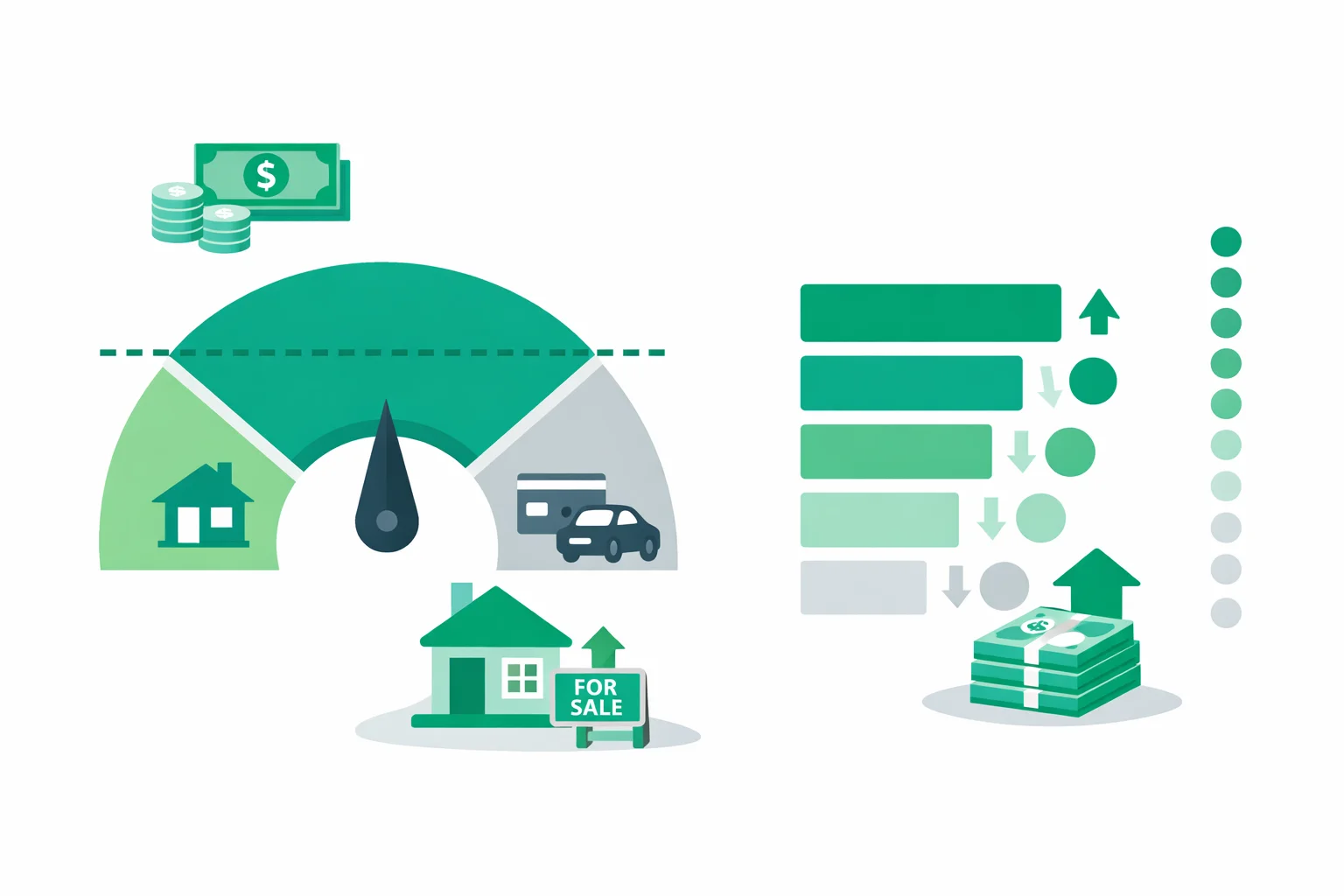
Your Salary Gets You in the Door. Your DTI Decides How Far.
Income opens the conversation, but the number a lender approves is governed by your debt-to-income ratio— DTI. It's the share of your gross monthly income that goes to debt payments, and it's the single lever underwriters weigh most heavily. Two buyers earning $7,500 a month look identical on a pay stub. Give one of them a $450 truck payment and a $250 student loan bill, and $700 of their monthly income is spoken for before a mortgage even enters the picture.
That $700 doesn't just dent the budget — it directly shrinks the approval. At a 45% DTI ceiling, $7,500 in income allows $3,375 in total monthly debt. Subtract the $700 already committed, and only $2,675 is left for the house payment. The debt-free twin keeps the full $3,375. That gap of $700 a month is worth roughly $110,000 in loan amount at today's rates. Same salary, six-figure difference.
The Two Ratios Every Underwriter Runs
Lenders actually calculate two ratios. The front-end ratio looks only at the housing payment — principal, interest, taxes, insurance, and HOA — as a percentage of gross income. The traditional comfort line is 28%. The back-end ratiois the one that usually binds: it adds every other monthly debt to the housing payment and divides by gross income. This is the number Fannie Mae and Freddie Mac's automated underwriting systems lean on, and it typically runs up to about 45%, with FHA stretching to 50% or more.
The formula is refreshingly plain:
Back-end DTI = (housing payment + all other monthly debt) ÷ gross monthly income
Rearranged, it tells you your maximum housing payment: multiply gross monthly income by your DTI limit, then subtract existing debts. On $7,500 a month at a 45% cap, that's $3,375 minus your debts. Whatever's left is the ceiling on your full PITI — and the calculator above works backward from that ceiling to a home price, accounting for the taxes, insurance, and PMI that ride along with the loan. The Consumer Financial Protection Bureau suggests keeping back-end DTI at or below 43% for comfortable borrowing.
What a $90,000 Salary Actually Qualifies For
Let's run a real file start to finish. Sarah earns $90,000 a year — $7,500 a month gross. She has a $400 car payment and $150 in student loans, so $550 of monthly debt. She's putting $40,000 down, her credit sits in the 700–739 band (call it a 6.72% rate), and she wants a 30-year loan. Her lender uses a 45% back-end DTI.
- Step 1 — DTI ceiling: 45% × $7,500 = $3,375 in total allowable monthly debt.
- Step 2 — Subtract existing debt: $3,375 − $550 = $2,825 available for the full house payment (PITI).
- Step 3 — Carve out taxes, insurance, and PMI:she's under 20% down, so the payment also carries PMI. On a ~$375,000 home that's about $343 in taxes, $150 in insurance, and $167 in PMI — roughly $660 total, leaving about $2,165 for principal and interest.
- Step 4 — Convert to a loan: $2,165 a month at 6.72% over 30 years supports about a $335,000 loan.
- Step 5 — Add the down payment: $335,000 + $40,000 ≈ a $375,000 home price.
Notice the loop in step 3: taxes and PMI scale with the home price, so the real math solves the price and the payment together — exactly what the calculator does instantly. Change one input and the whole chain re-runs. Once you know your loan amount, the standard mortgage calculator confirms the payment behind it down to the dollar.
How Much Your Credit Score Quietly Changes the Number
Credit score doesn't just decide whether you're approved — it decides how much, because it sets your rate, and the rate sets how far each dollar of payment stretches. Hold income and debt fixed and move only the score, and the approved price swings by tens of thousands. Here's the same $90,000 borrower with $550 of debt and $40,000 down, priced across credit bands:
| Credit Band | Typical Rate | Approx. Approved Price | vs. 740+ |
|---|---|---|---|
| 740+ | 6.50% | $381,000 | — |
| 700–739 | 6.72% | $375,000 | −$6,000 |
| 660–699 | 6.98% | $367,000 | −$14,000 |
| 620–659 | 7.40% | $356,000 | −$25,000 |
| 580–619 | 8.15% | $338,000 | −$43,000 |
On this modest $375,000 file the spread from top to bottom is about $43,000 of buying power — created entirely by rate, not income, and it widens on a larger loan. That's why nudging a 690 score up to 720 before you apply can be the highest-return hour you spend all year. Moving from the 660–699 band into 700–739 is worth roughly $8,000 more house here, and about $14,000 if you crack 740. Pay down a maxed card, dispute a reporting error, and wait for the next statement cycle; a 20-point jump can move you a full band.
Approval and Affordability Are Not the Same Number
This trips up almost everyone. Approval is the lender's ceiling — the most they'll hand you based on ratios. Affordability is what actually fits your life once you've paid for daycare, retirement, groceries, and the occasional broken water heater. Lenders don't see your $600 monthly childcare bill or your goal of maxing a Roth IRA, because none of that shows up on a credit report.
A 45% DTI approval can leave you "house poor" — technically qualified, practically stretched. Plenty of financial planners suggest keeping the housing payment closer to 25–28% of gross income even when a lender will bless far more. If your approval says $2,825 a month but your comfortable number is $2,300, borrow to the smaller figure. Run both: use this tool for the ceiling, then the home affordability calculator for the payment you can genuinely live with. The right price is usually the lower of the two.
Pay Down This Before You Apply — Not That
Because back-end DTI counts the monthly payment, not the total balance, the smartest move is to kill the debts with the worst payment-to-balance ratio. A $28,000 car loan at $580 a month is a DTI disaster — it blocks roughly $90,000 of house for a balance you could nearly cover with the down payment you already saved. A $15,000 student loan at $130 a month barely moves the needle.
- Kill first: car loans and personal loans with high payments relative to the balance. Eliminating a $450 payment can add $65,000–$80,000 to your approval.
- Pay down, don't close: credit cards — their minimums count against DTI, so lowering balances helps your ratio and your score at once. Keep the accounts open to preserve credit history.
- Usually leave alone: low-payment student loans and anything with fewer than about 10 payments left, which some lenders exclude from DTI entirely.
One caution: don't drain the cash a lender wants to see. Paying off a car the week before you apply, then showing up with a thin bank account and no reserves, can hurt more than the DTI improvement helps. If a bigger down payment is on the table instead, the down payment calculator shows how crossing 20% down erases PMI and shrinks the payment inside your ratio.
Pre-Qualification, Pre-Approval, and the Real Thing
These terms get used interchangeably, and they shouldn't be. There's a ladder, and each rung carries more weight:
- Pre-qualificationis an estimate from numbers you state — no documents pulled. Fast, free, and soft. That's the category this calculator falls into: a realistic target, not a promise.
- Pre-approvalcomes after a lender pulls your credit and reviews pay stubs, W-2s, and bank statements. It produces a letter sellers respect, and it's usually good for 60–90 days.
- Underwriting and commitmentis the final word — issued once there's a specific property, an appraisal, and a full document review.
In practice, get a real pre-approval before you tour homes. In competitive markets, most sellers won't even consider an offer without a verified letter attached — a pre-qualification printout doesn't cut it.
Where This Estimate and the Underwriter Part Ways
A calculator runs clean math on the numbers you type. A human underwriter runs messier rules on documents. The gaps that most often surprise borrowers:
- Self-employed income is averaged over two years of tax returns and reduced by write-offs. The $120,000 you grossed might qualify like $80,000 after deductions.
- Overtime, bonus, and commission usually need a two-year history to count, and are averaged. A recent raise or a brand-new bonus structure may not fully count yet.
- Student loans on income-driven plans can be counted at 0.5%–1% of the balance instead of your actual $0–$50 payment, quietly inflating your DTI by hundreds.
- Reserves and gift funds have their own rules — lenders want to see months of payments in the bank, and gifted down payments require a documented paper trail.
Treat the approval figure as a well-informed starting point, not a verdict. It gets you most of the way there; a loan officer closes the gap with your actual paperwork. For a program-by- program view, the VA loan calculator shows how eligible veterans qualify on residual income rather than a hard DTI cap.
Mistakes That Sink an Approval After You Get It
Getting pre-approved isn't the finish line — it's a snapshot the lender re-checks right before closing. These moves have blown up deals days before the keys changed hands:
- Financing a car mid-process. A new $500 payment can push your DTI past the limit and un-approve you overnight. Wait until after closing to buy anything on credit.
- Opening or closing credit cards.Both jolt your score and your DTI. A "12 months, no interest" furniture card is a great way to lose a mortgage.
- Changing jobs. Switching from salaried to self-employed, or starting a role with a probationary period, can void the income the lender approved.
- Large unexplained deposits.A surprise $8,000 in your account triggers a paper-trail request. Undocumented cash can't be used and can stall underwriting.
The rule from pre-approval to closing is boring on purpose: freeze your finances. Same job, same debts, no new credit, no big unexplained money. Do that, keep your DTI where the calculator put it, and the approval you got in week one is the approval that's still standing at the closing table.