Wallpaper Calculator: How Pattern Repeat and Room Size Determine Roll Count
A wallpaper calculator that only multiplies square feet will lie to you by a full roll or two, because the one number that decides your order isn't on the wall — it's the pattern repeat printed on the roll label. Two papers can cover the exact same 12×14 room, and the one with a 25-inch repeat needs 11 rolls while a plain textured paper needs 8. That's a $100-plus swing on the same four walls, driven entirely by how much you trim off the top of every strip to line the design up. This tool counts strips the way an installer does, so the repeat is baked into the answer instead of ambushing you at the seam.
The Pattern Repeat Tax: Why a Big Print Costs You Rolls
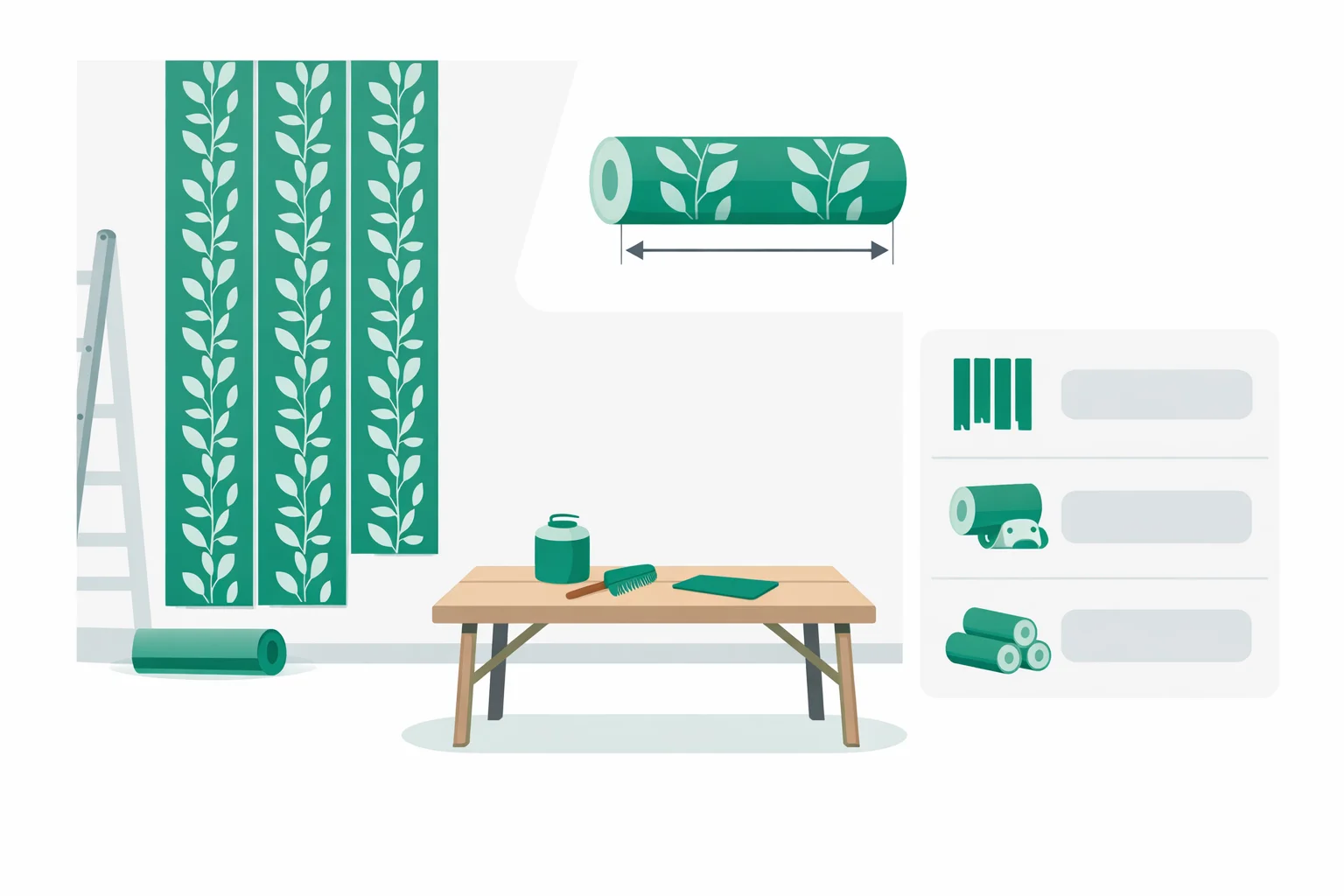
Pattern repeat is the vertical distance between one point in the design and the next identical point — the height of a single tile of the print. A small geometric might repeat every 4 inches; a large botanical or damask can repeat every 24 to 27 inches. Here's why that number quietly inflates your order.
Every strip on the wall has to start at the same place in the pattern so the design flows across the seam. To get there, you cut each strip not to the wall height but up to the next full repeat above it. On a 9-foot wall (108 inches) with a 19-inch repeat, you can't cut a 108-inch strip — you cut 114 inches, the next multiple of 19. With a 25-inch repeat you'd cut 125 inches. That extra material is trimmed off and thrown away on every single strip, and it's the whole reason a bold print eats more rolls than a quiet one.
The tax compounds with ceiling height. A roll only yields whole strips, so when the cut length crosses a threshold, your strips-per-roll drops from 3 to 2 and your roll count jumps by half. That's why pricing the paper alone tells you almost nothing — you have to know the repeat before you can know the cost.
Why Pros Count Strips, Not Square Feet
Square-footage math fails on wallpaper for one stubborn reason: you can't paste a half-height leftover onto a full-height wall. A European roll rated at 56 square feet sounds like plenty for a 40-square-foot wall — until you realize the roll gives you three 9-foot strips and a useless 6-foot tail. That tail is real square footage you paid for and can't hang.
The installer's method sidesteps the trap. It works in four steps:
- 1. Count the drops. Divide the room perimeter by the roll width to get the number of vertical strips (drops) you need.
- 2. Size each cut. Take the wall height, add a few inches of trim, and round up to the next pattern repeat.
- 3. Strips per roll.Divide the roll's length by that cut length and round down— partial strips don't count.
- 4. Rolls. Divide total drops by strips-per-roll and round up.
This is exactly what the calculator does, and it's why its answer can differ from a big-box store's area estimator by a roll or more. If you want to sanity-check the wall area itself before you start, our square footage calculator gives you the raw perimeter and area to feed in here.
Straight, Drop, or Random Match — What Each One Costs
The label tells you how the pattern lines up across seams, and the three types waste wildly different amounts of paper.
Random (free) matchmeans there's no horizontal alignment to worry about — stripes, grasscloth, many textures. You cut every strip to wall height plus trim and waste almost nothing. This is the cheapest paper to hang per square foot.
Straight match repeats the same motif at the same height on the next strip, so each strip rounds up to a full repeat. A 19-inch repeat on a 9-foot wall costs you about 6 inches of trim per strip — manageable, but it adds up across 29 strips.
Half-drop matchstaggers every other strip down by half a repeat, which is what makes diamond and ogee patterns look continuous. The catch is that the alternating offset wastes up to an extra half repeat, so a half-drop paper often needs one more roll than the same repeat in a straight match. On the calculator, flip between the three and watch the roll count move while everything else stays fixed — that's the pattern match doing its damage in real time.
Papering a Real 12×14 Room, Strip by Strip
Let's hang a straight-match floral, 20.5 inches wide, 33 feet long, 19-inch repeat, on a 12×14 room with 9-foot ceilings, one doorway and two windows. Paper runs $35 a roll.
- Perimeter: 2 × (12 + 14) = 52 ft = 624 inches. Subtract one 32-inch doorway → 592 inches.
- Drops needed: 592 ÷ 20.5 = 28.9, round up to 29 strips.
- Cut length: 108-inch wall + 4-inch trim = 112, round up to the next 19-inch repeat → 114 inches per strip.
- Strips per roll: 396-inch roll ÷ 114 = 3.47, round down to 3 full strips.
- Rolls: 29 strips ÷ 3 = 9.7, round up to 10 rolls.
- Cost: 10 × $35 = $350, and that buys ~564 sq ft of paper to cover ~417 sq ft of wall — about 26% trim and waste.
The lesson hiding in those numbers: the roll yields only 3 strips because 114 inches divides into 396 just over three times, throwing away the leftover 54 inches at the end. Shave the repeat to a random match and the cut drops to 112 inches — still 3 strips, no change here, which tells you the height is the binding constraint in this room, not the pattern. Run your own numbers above and the trim percentage flags instantly whether a shorter repeat or a different roll length would buy back a roll.
European Rolls vs American Rolls: Read the Label First
The single most common ordering error is multiplying the right room by the wrong roll. Roll sizes are not standardized, and the gap is wide enough to throw your count off by several rolls.
| Roll type | Width | Length | Gross area |
|---|---|---|---|
| European / UK roll | 20.5 in | 33 ft | ~56 sq ft |
| American single roll | 27 in | 13.5 ft | ~30 sq ft |
| American double roll | 27 in | 27 ft | ~60 sq ft |
| Peel & stick roll | 24 in | 18 ft | ~36 sq ft |
The pricing trap hides here too: American wallpaper is frequently quoted per single roll but only sold in double rolls. If a listing shows $40 a roll and the bolt that arrives is a double, you're actually paying $80 per package. Always confirm whether the price and the package use the same unit before you multiply by your roll count. Wider American rolls also need fewer strips to span the perimeter, which can offset the shorter length — another reason to plug your exact label numbers into the calculator rather than trusting a generic estimate.
Rolls by Room Size and Pattern Repeat
Use this for a fast gut-check before you measure. Every figure assumes a European roll (20.5 in × 33 ft), 9-foot ceilings, straight match, and one doorway subtracted. Notice how the same room climbs as the repeat grows.
| Room size | Plain (0 in) | Small (10 in) | Large (21 in) |
|---|---|---|---|
| 10×10 | 6 rolls | 7 rolls | 8 rolls |
| 12×12 | 7 rolls | 8 rolls | 10 rolls |
| 12×14 | 8 rolls | 9 rolls | 10 rolls |
| 14×16 | 9 rolls | 10 rolls | 12 rolls |
| 16×20 | 11 rolls | 12 rolls | 14 rolls |
The jump from the plain column to the large-repeat column is the cost of the print you fell in love with — usually one to two extra rolls per room. If you're still weighing wallpaper against paint for the same walls, our paint calculator sizes a two-coat repaint so you can compare the real material cost of each finish.
Wallpaper Mistakes That Leave You a Roll Short
- Estimating by coverage square footage.A roll's 56 sq ft rating ignores the unusable tail and trim — real yield is often 40 to 46 sq ft. Size a room on the rated number and you come up one to two rolls short, a second order at $35-plus a roll.
- Ignoring the pattern repeat.Counting a large-repeat paper as if it were plain undershoots by 15 to 25 percent — roughly one extra roll per room you didn't buy.
- Mixing run numbers. Two rolls from different dye lots can dry a shade apart, leaving a visible seam. Buy one extra roll in the same batch now; reordering later almost never matches.
- Forgetting tall walls cut strips-per-roll. A 10-foot ceiling can knock a roll from 3 strips to 2, raising the count 40 to 50 percent over the same footprint at 8 feet.
- Buying single when the listing means double. Quoting yourself the single-roll price on double-roll packages can double your actual spend at checkout.
Where This Estimate Needs a Second Look
This calculator sizes rectangular rooms with standard rolls, which covers most jobs. A few situations need a manual adjustment. Staircases and sloped or vaulted walls have strips of different lengths, so measure the longest drop and add 10 to 15 percent rather than trusting a single height. Murals and panel sets are sold by the panel for a specific wall size, not by repeat, so the strip method doesn't apply — order to the manufacturer's wall chart instead.
Surface prep is the other variable. New or patched drywall usually needs a wallpaper primer or sizing so the paper adheres and comes off cleanly later, and that's a separate purchase from the rolls. If you're stripping old wallpaper in a home built before 1978, the underlying paint can contain lead, and the EPA's Renovation, Repair and Painting rule lays out the safe-work practices for sanding and scraping. Adhesives and primers carry their own fumes, so the EPA's guidance on VOCs and indoor air quality is worth a read before you paper a nursery or a poorly ventilated room. And if the wall behind your vanity or backsplash is really getting tile rather than paper, our tile calculator handles that side of the room.