Truss Calculator: How to Size and Space Roof Trusses for Your Build
A truss calculator takes the guesswork out of roof framing by converting your span, pitch, and load requirements into exact member lengths, lumber sizes, and material quantities. Whether you're pricing out a new garage, planning an addition, or comparing bids from truss manufacturers, knowing your numbers before the first phone call saves both time and money. Most residential builds use prefabricated trusses, and getting the specs right up front means fewer change orders and no scrambling at the lumber yard.
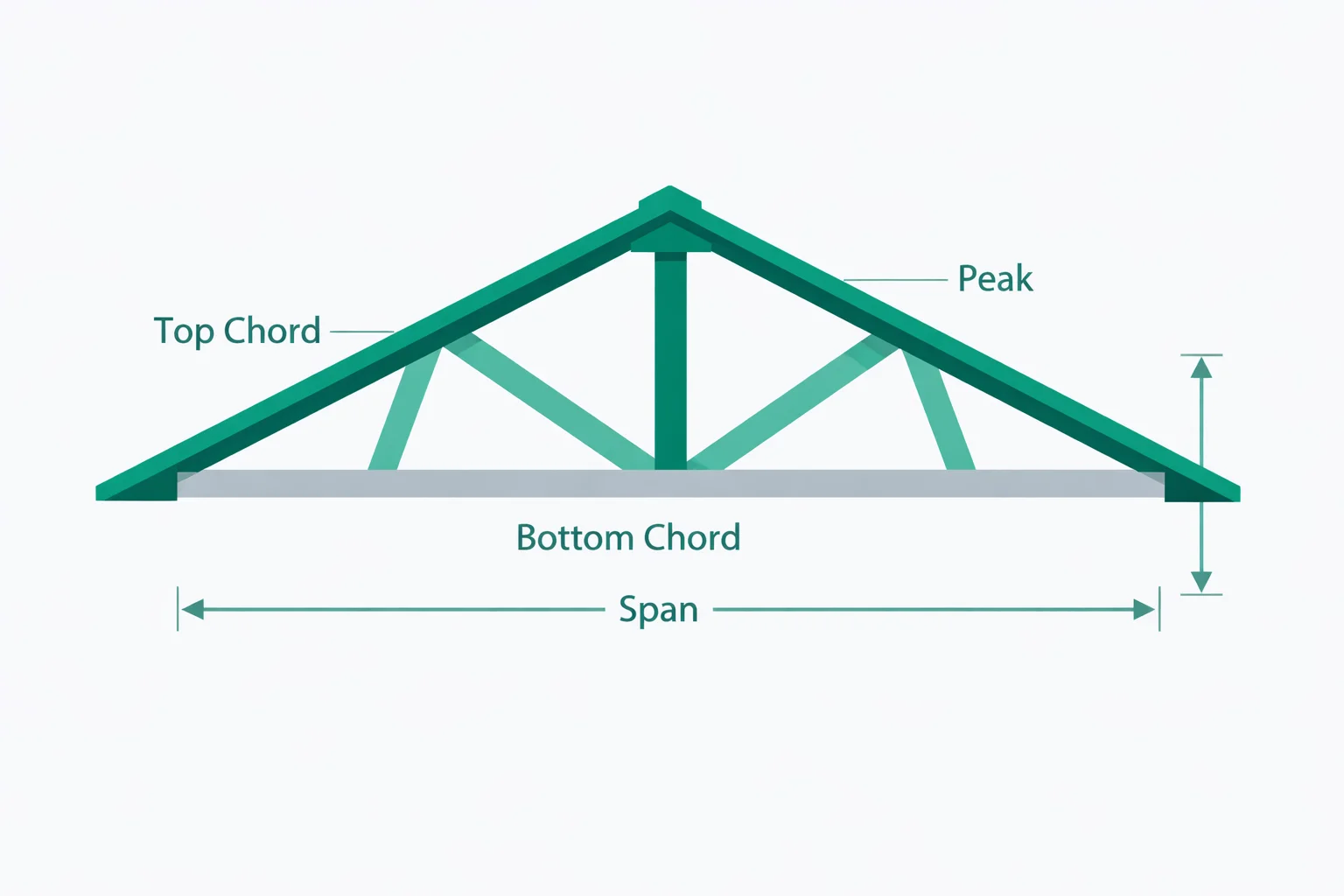
What Is a Roof Truss?
A roof truss is a prefabricated triangular frame that supports the roof deck and transfers loads down to the exterior walls. It consists of three main parts: two top chords (the sloped members that carry the roofing), one bottom chord (the horizontal member that resists outward thrust and often doubles as ceiling framing), and web members (the interior diagonals and verticals that brace the chords and distribute forces). Steel connector plates — stamped metal gussets — hold the joints together.
Unlike stick-framed rafters that require a ridge board and ceiling joists to work as a system, a truss is structurally complete on its own. That's why trusses don't need interior bearing walls below them. The triangulated geometry turns bending forces into pure tension and compression along the members, which is structurally very efficient.
Truss Types and When to Use Them
Picking the right truss type isn't complicated, but it does affect cost, attic space, and structural performance. Here's what each type is actually good for:
- Fink (W-pattern)— The workhorse of residential construction. Two diagonal webs form a W shape that efficiently handles spans up to about 36 feet. Roughly 80% of new homes use Fink trusses because they're cheap to manufacture and plenty strong for typical loads.
- Howe — Vertical web members with diagonal braces. Better than Fink for spans over 30 feet because the verticals resist compression loads more directly. Slightly more expensive due to extra connector plates.
- King Post — The simplest truss design: just a single center vertical post. Works for small spans up to about 20 feet — sheds, carports, porches. Inexpensive but limited in span.
- Queen Post — Two vertical posts create a wider flat section at the center. Good when you want usable attic space or need to run ductwork through the truss cavity.
- Scissors — The bottom chord slopes upward toward the center, creating a vaulted ceiling below. The catch? Scissors trusses produce significant outward thrust at the bearing walls and typically need larger members. Plan on 20-30% more material cost.
How to Calculate Truss Dimensions
The core geometry of a truss comes from two numbers: span and pitch. Here's the math for a standard symmetrical truss:
Run = Span ÷ 2
Rise (peak height) = Run × (Pitch ÷ 12)
Top chord length = Run × √(1 + (Pitch ÷ 12)²)
Worked example: You're building a 28-foot-wide garage with a 6/12 pitch.
- Run = 28 ÷ 2 = 14 ft
- Rise = 14 × (6 ÷ 12) = 7 ft peak height
- Top chord = 14 × √(1 + 0.25) = 14 × 1.118 = 15.65 ft each side
- Bottom chord = 28 ft (full span)
For a Fink truss on this span, each outer diagonal web runs about 15.65 ft, and the inner verticals are about 3.5 ft each. Total lumber per truss: roughly 85 linear feet. If you're curious about the slope angle itself, our roof pitch calculator converts between pitch ratios, degrees, and percentages.
Truss Spacing and Load Requirements
Spacing determines how many trusses you need and how much load each one carries. The tributary area — the width of roof surface each truss supports — equals the spacing distance.
| Spacing | Tributary Width | Best For | Trusses per 40 ft |
|---|---|---|---|
| 16" OC | 1.33 ft | Heavy snow, tile roofs, long spans | 31 |
| 24" OC | 2.0 ft | Standard residential (most common) | 21 |
| 48" OC | 4.0 ft | Carports, light-duty with heavy sheathing | 11 |
Load requirements come from your local building code. Dead load covers the weight of roofing materials — asphalt shingles add about 10-15 psf, while clay tiles run 15-25 psf. Live load accounts for snow, wind, and maintenance access. The IRC (International Residential Code) specifies minimum live loads of 20 psf for most areas, but northern states often require 40-60 psf or more for ground snow load.
Trusses vs. Rafters: Which to Choose
This is the question every builder faces. Short answer: trusses win on cost and speed for most new construction. Rafters win on flexibility and attic space. Here's the honest comparison:
| Factor | Trusses | Rafters |
|---|---|---|
| Installation speed | 1-2 days (crane sets) | 3-5 days (cut on site) |
| Labor cost | 30-50% less | Higher (skilled framing) |
| Clear span | Up to 60+ ft | Usually max 24 ft |
| Attic space | Limited (webs block it) | Full open attic |
| Customization | Must order ahead | Modify on site |
| Vaulted ceiling | Scissors truss (costly) | Natural fit |
If you're leaning toward stick framing, the rafter calculator will give you exact lengths, cut angles, and material quantities for common, hip, and valley rafters.
Lumber Sizing and Material Selection
Lumber grades and species matter more than most DIYers realize. Truss manufacturers typically use #2 or better SPF (Spruce-Pine-Fir) or SYP (Southern Yellow Pine). SYP is about 20% stronger in bending, so it shows up in trusses designed for longer spans or heavier loads.
For residential trusses with spans under 30 feet and standard loads (35 psf total), 2×4 members handle both chords and webs. Once you cross 30 feet, top chords usually jump to 2×6 because the compression forces along the slope increase with span squared — a 36-foot truss carries nearly double the chord force of a 24-footer. For spans over 40 feet, expect 2×6 throughout with possible 2×8 bottom chords.
Web members almost always stay at 2×4 regardless of span, since they carry axial loads only (tension or compression, no bending). The board foot calculator can help you convert linear footage to board feet for lumber pricing.
Common Truss Sizing Mistakes
These errors show up constantly on residential builds. Each one can cost you $500-$5,000 or trigger a failed inspection:
- Ignoring snow load.Using 20 psf live load in a 40 psf snow zone undersizes every truss. The fix? Check your county's ground snow load map before ordering. A truss designed for 20 psf that sees 40 psf is loaded to double its rated capacity.
- Forgetting the truss at each end.A 40-foot building at 24" OC needs 21 trusses, not 20. The off-by-one error seems minor until you're short one truss and waiting two weeks for a replacement delivery.
- Cutting or modifying trusses on site. Cutting a web member to run ductwork or plumbing voids the engineering certification. It can also cause a catastrophic failure under load. If you need openings, specify them on the truss order so the engineer designs around them.
- Not accounting for gable-end trusses.The first and last trusses on a gable roof are typically flat (non-structural) gable trusses with vertical studs for sheathing attachment. They're a different item on the order — not just regular trusses turned sideways.
What Drives Truss Costs Up (and How to Save)
Prefabricated truss prices depend on span, pitch, type, and volume. Here's what actually moves the needle:
- Span over 36 feet bumps lumber from 2×4 to 2×6, roughly doubling material cost per truss. If you can design around a center bearing wall, two shorter trusses cost less than one long one.
- Custom configurations (scissors, attic trusses, piggyback) require individual engineering and cost 50-100% more than standard Fink trusses.
- Delivery and crane rental add $500-$1,500 to the project but are usually unavoidable for trusses over 24 feet.
- Volume discountskick in around 15-20+ trusses. If you're ordering fewer, ask your supplier if they have stock designs that match your span and pitch — stock configurations skip the custom engineering fee.
For a complete picture of your roof framing budget, run the numbers through our roofing calculator to estimate sheathing, underlayment, and shingle costs on top of the truss structure.
When to Use This Calculator
- Before requesting bids.Walk into the conversation with exact truss counts, member sizes, and approximate costs. Contractors take you more seriously when you know the numbers — and you'll spot inflated quotes immediately.
- During design phase. Compare how different pitches, spacings, and truss types affect your material costs before committing to a roof design.
- For permit applications. Building departments want to see truss specs. This calculator gives you the starting point; the truss manufacturer provides the stamped engineering drawings.
- When evaluating trusses vs. rafters. Run both calculations side by side. For most rectangular buildings over 20 feet wide, prefab trusses come out 30-40% cheaper in total installed cost.