APY Calculator: How Annual Percentage Yield Works and Why It Matters for Your Savings
An APY calculator converts a nominal interest rate into the true annual return you earn after compounding — the single number that tells you exactly how much your money grows in one year. If you're comparing savings accounts, CDs, or money market funds, APY is the only metric that gives you an apples-to-apples comparison. A bank advertising 5.00% compounded daily actually yields 5.127%, while the same rate compounded annually stays at exactly 5.00%. On a $50,000 deposit, that small gap means $63 more per year — money you'd leave on the table without checking.
What Is APY (Annual Percentage Yield)?
APY stands for Annual Percentage Yield. It represents the real rate of return earned on a savings deposit or investment over one year, accounting for the effect of compound interest. Unlike the nominal (stated) interest rate, APY factors in how often interest is compounded — daily, monthly, quarterly, or annually.
Think of it this way: the nominal rate is the headline number a bank advertises. APY is what you actually earn. When interest compounds, each interest payment starts earning its own interest. The more frequently this happens, the higher the effective yield. This is why two accounts with the same stated rate can produce different earnings depending on their compounding schedule.
The APY Formula: How to Calculate It
The standard APY formula is:
APY = (1 + r/n)n− 1
Where r is the nominal annual interest rate (as a decimal) and n is the number of compounding periods per year.
Worked example: A bank offers 4.80% compounded monthly.
- r = 0.048, n = 12
- APY = (1 + 0.048/12)12 − 1
- APY = (1 + 0.004)12 − 1
- APY = 1.04907 − 1 = 4.907%
That extra 0.107% means an additional $10.70 per $10,000 per year. On a $50,000 balance, it adds $53.50. The formula works the same for any compounding frequency — just change n to 365 for daily, 4 for quarterly, or 2 for semi-annual. Use our compound interest calculator to see how these differences grow over multiple years.
APY vs. APR: What's the Difference?
APY and APR are mirror images used in different contexts:
- APY (Annual Percentage Yield)— measures what you earn on deposits. Includes compounding. Higher is better.
- APR (Annual Percentage Rate)— measures what you pay on loans. Usually excludes compounding. Lower is better.
A credit card with 24% APR actually costs more than 24% per year because the interest compounds monthly, producing an effective rate of 26.82%. On the savings side, a 5.00% nominal rate with daily compounding gives you a 5.13% APY. Banks are required by the Truth in Savings Act (Regulation DD) to disclose APY on deposit accounts, making it the standard comparison metric.
How Compounding Frequency Affects APY
The table below shows how the same 5.00% nominal rate produces different APY values based on compounding frequency:
| Compounding | Periods (n) | APY | Interest on $10,000 |
|---|---|---|---|
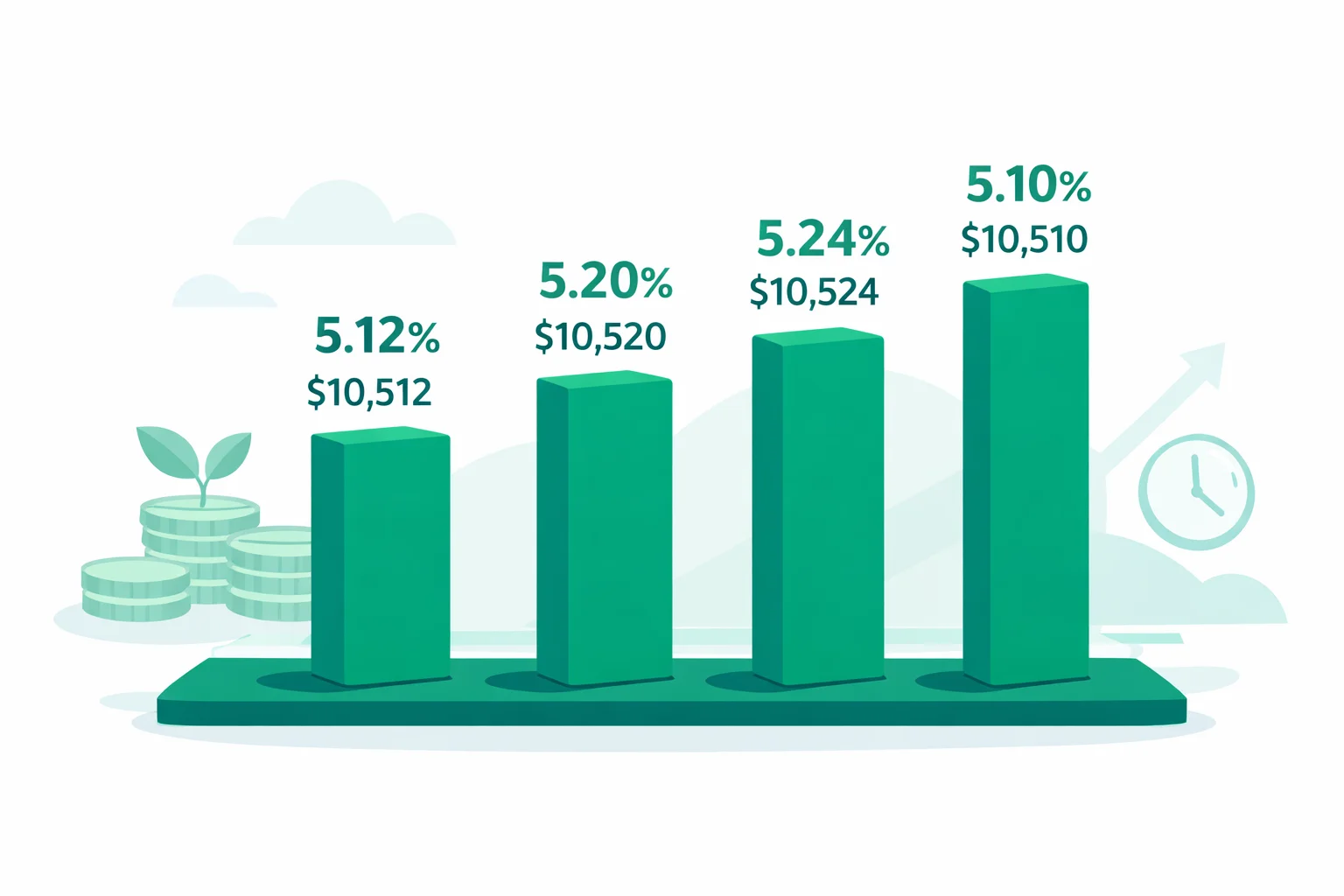
| Daily | 365 | 5.127% | $512.67 |
| Monthly | 12 | 5.116% | $511.62 |
| Quarterly | 4 | 5.095% | $509.45 |
| Semi-Annually | 2 | 5.063% | $506.25 |
| Annually | 1 | 5.000% | $500.00 |
The difference between daily and annual compounding at 5.00% is $12.67 per $10,000. On a $100,000 balance, that gap grows to $126.70 per year. More importantly, the advantage compounds year over year. Over 10 years, daily compounding on $100,000 at 5.00% earns $1,489 more than annual compounding.
Real Dollar Impact: APY on $10,000 to $100,000
Here's what different APY rates actually mean in dollars, assuming daily compounding with no additional contributions:
| Deposit | 3.50% APY (1yr) | 4.50% APY (1yr) | 5.25% APY (1yr) |
|---|---|---|---|
| $10,000 | $350 | $450 | $525 |
| $25,000 | $875 | $1,125 | $1,313 |
| $50,000 | $1,750 | $2,250 | $2,625 |
| $100,000 | $3,500 | $4,500 | $5,250 |
Moving from 3.50% to 5.25% APY on a $50,000 emergency fund earns an extra $875 per year — that's a meaningful amount for simply choosing a different bank. Use our savings calculator to project how these rates compound over 5, 10, or 20 years with monthly contributions.
Common Mistakes When Comparing Bank Rates
- Comparing nominal rates instead of APY. A bank offering 4.90% compounded daily (APY 5.02%) beats one offering 5.00% compounded annually (APY 5.00%). Always compare APY, not the headline rate.
- Ignoring rate tiers and balance requirements. Some banks advertise a top APY that only applies to balances under $10,000 or over $100,000. The rate on your actual balance could be 1-2% lower.
- Forgetting introductory rate expiration.Many online banks offer a promotional APY (e.g., 5.50% for 3 months) that drops to 4.00% afterward. On a $25,000 deposit, that's a $375 per year difference after the promo ends.
- Overlooking fees that offset interest.A monthly maintenance fee of $5 wipes out $60 per year — equivalent to losing 0.60% APY on a $10,000 balance. A fee-free account at 4.50% APY beats a 5.10% account with a $12/month fee on balances under $24,000.
Tips to Maximize Your APY Earnings
- Shop online banks first. Online-only banks consistently offer 0.5% to 1.5% higher APY than brick-and-mortar banks because they save on branch overhead. This alone can mean $250 to $750 more per year on a $50,000 balance.
- Use a CD ladder for rate certainty. If rates are high, lock in a portion of your savings with CDs (e.g., 1-year at 5.10%, 2-year at 4.85%). This protects against rate drops while keeping some funds accessible.
- Keep emergency funds in a high-yield account, not checking. The average checking account pays 0.07% APY. Moving a $20,000 emergency fund to a 4.75% APY savings account earns $936 per year instead of $14.
- Watch for rate changes quarterly.Savings account APY fluctuates with the Federal Reserve rate. Set a calendar reminder to check your rate against competitors every 3 months — switching banks takes about 15 minutes and could earn you hundreds more.
- Check FDIC/NCUA insurance limits. Keep balances under $250,000 per depositor per institution to maintain full insurance coverage. If you have more, split across multiple banks to stay protected while earning the best rates. You can also explore mortgage payment planning to understand how your savings APY compares to mortgage interest costs.
When to Use This APY Calculator
- Comparing savings accounts— enter each bank's nominal rate and compounding schedule to see which actually pays more.
- Evaluating CD offers— convert a CD's quoted rate to APY to compare against your current savings account yield.
- Verifying bank disclosures— confirm that the APY your bank advertises matches the nominal rate and compounding frequency they list in the fine print.
- Understanding compounding impact— see exactly how much more daily compounding earns versus monthly or quarterly on your specific balance.
- Projecting earnings on a lump sum— find out how much a specific deposit earns at a given APY over 1 to 20 years.