How to Calculate Sphere Volume, Surface Area, and Tank Capacity
A sphere volume calculatorlets you instantly determine how much space a ball, globe, tank, or dome occupies — no manual math required. Whether you're sizing a spherical water tank, estimating the volume of a sports ball, or calculating material for a dome structure, knowing the exact volume in cubic feet, gallons, or liters saves time and prevents costly over- or under-ordering. This guide walks through the formula, real-world examples, surface area, hemisphere calculations, and common pitfalls so you can use the calculator with confidence.
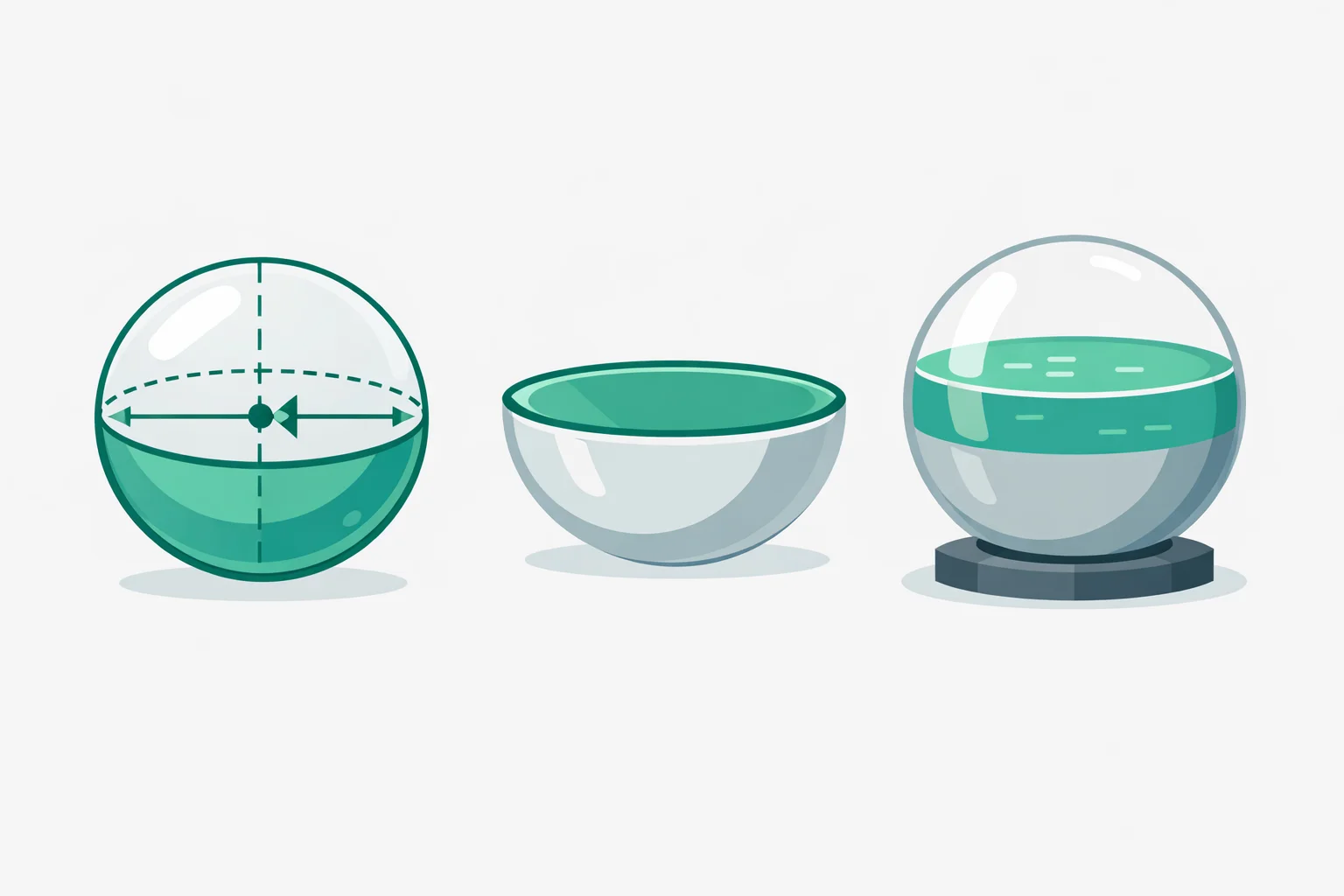
What Is Sphere Volume?
Sphere volume is the amount of three-dimensional space enclosed inside a perfectly round shape where every point on the surface is an equal distance from the center. That distance is the radius. Volume is measured in cubic units — cubic feet (ft³), cubic inches (in³), cubic meters (m³) — and tells you how much liquid, gas, or material the sphere can hold.
Spheres appear everywhere: water storage tanks, propane tanks, exercise balls, decorative globes, dome roofs, and even natural objects like oranges and boulders. Unlike a box or cylinder, a sphere has no edges or flat surfaces, which makes it the most efficient shape for holding volume relative to surface area.
The Sphere Volume Formula
The standard formula for sphere volume is:
V = (4/3) × π × r³
Where V is volume, π is approximately 3.14159, and r is the radius. If you only know the diameter (d), remember that r = d / 2.
Step-by-step worked example: Calculate the volume of a sphere with a 3-foot radius.
- Cube the radius: 3³ = 27
- Multiply by π: 27 × 3.14159 = 84.823
- Multiply by 4/3: 84.823 × 1.3333 = 113.10 cubic feet
That 113.10 ft³ equals about 846 US gallons or 4.19 cubic yards. For context, 846 gallons is roughly the volume of a large hot tub.
Worked Examples with Real Dimensions
Let's walk through several practical sphere volume calculations you might encounter at home or on a job site.
Example 1 — Basketball: A standard basketball has a diameter of about 9.43 inches (radius = 4.715 in). Volume = (4/3) × π × 4.715³ = 439.0 cubic inches, which is 0.254 ft³ or about 1.9 gallons.
Example 2 — 4-foot spherical propane tank: Diameter = 4 ft, so radius = 2 ft. Volume = (4/3) × π × 2³ = 33.51 ft³ = 250.7 gallons. A typical home propane tank holds 500 gallons, so this sphere would hold about half that amount.
Example 3 — 10-foot decorative globe sculpture: Diameter = 10 ft, radius = 5 ft. Volume = (4/3) × π × 5³ = 523.6 ft³ = 19.39 cubic yards. If you need to fill this with concrete at $150 per cubic yard, material alone costs about $2,909. You can use our cubic yard calculator to verify bulk material estimates.
Sphere Surface Area Explained
Surface area tells you how much material covers the outside of a sphere — critical for painting, coating, insulation, or wrapping. The formula is:
A = 4 × π × r²
A sphere with a 5-foot radius has a surface area of 4 × π × 25 = 314.16 square feet. If a gallon of paint covers 350 sq ft, you'd need just under 1 gallon. Compare that to the volume of 523.6 ft³ — the sphere holds a lot of space relative to the amount of surface you need to cover. That's why spherical tanks are material-efficient.
For reference, a sphere has the lowest surface-area-to-volume ratio of any 3D shape. This means less material for the same capacity compared to a cylinder or rectangular container.
How to Calculate Hemisphere Volume
A hemisphere is half a sphere, cut through the center. The formula is simply:
V = (2/3) × π × r³
Example:A dome roof with a 12-foot diameter (6-foot radius) has a volume of (2/3) × π × 216 = 452.39 ft³. That's 16.76 cubic yards of interior space under the dome. Hemisphere calculations apply to dome roofs, bowl-shaped planters, half-round water features, and igloo-style structures.
Keep in mind the surface area of a hemisphere includes both the curved top (2πr²) and the flat circular base (πr²), totaling 3πr². If you only need the curved surface — for example, painting just the dome exterior — use 2πr² instead.
Common Sphere Sizes Reference Table
Use this table to quickly look up the volume of common spherical objects without running the calculation manually:
| Object | Diameter | Volume | Gallons |
|---|---|---|---|
| Golf ball | 1.68" | 2.48 in³ | 0.011 |
| Softball | 3.82" | 29.19 in³ | 0.126 |
| Basketball | 9.43" | 439.0 in³ | 1.90 |
| Exercise ball | 26" | 9,203 in³ | 39.85 |
| 3-ft tank | 36" | 14.14 ft³ | 105.8 |
| 5-ft tank | 60" | 65.45 ft³ | 489.6 |
| 8-ft tank | 96" | 268.1 ft³ | 2,005 |
| 10-ft tank | 120" | 523.6 ft³ | 3,917 |
Spherical Tank and Container Capacity
Spherical tanks are used for propane, natural gas (LNG), water storage, and chemical processing because the sphere distributes pressure evenly in all directions. When sizing a tank, always convert cubic feet to gallons or liters for practical capacity:
- 1 cubic foot = 7.48 US gallons = 28.32 liters
- 1 cubic meter = 264.17 US gallons = 1,000 liters
A critical detail: doubling the diameter of a spherical tank increases volume by 8 times, not 2 times. A 4-foot tank holds 251 gallons, but an 8-foot tank holds 2,005 gallons — 8× more. This cubic scaling means small increases in size yield large gains in capacity, which is why precise measurements matter. For other container shapes, try our general volume calculator which handles boxes, cylinders, cones, and pyramids.
Common Mistakes When Calculating Sphere Volume
- Confusing radius and diameter: Using the diameter (10 ft) where the formula expects the radius (5 ft) gives a result 8 times too large. Always divide the diameter by 2 before plugging into V = (4/3)πr³.
- Mixing units: If you measure the radius in inches but calculate in feet, your volume will be off by a factor of 1,728 (12³). Convert all measurements to the same unit before calculating.
- Forgetting wall thickness: A spherical tank with 1-inch thick walls has an inner radius smaller than the outer. For a 24-inch outer diameter tank with 1-inch walls, inner diameter is 22 inches — reducing usable volume from 7,238 in³ to 5,575 in³, a 23% loss.
- Ignoring cubic scaling:Assuming double the diameter = double the volume. It's actually 8× the volume. A 6-ft tank doesn't hold "a little more" than a 5-ft tank — it holds 73% more (65.45 vs 113.1 ft³).
Tips for Accurate Sphere Calculations
- Measure the diameter, not the radius:It's easier to measure the widest point across a sphere (diameter) than from center to edge (radius). The calculator converts automatically.
- Take 3 measurements and average: Real-world spheres are rarely perfect. Measure diameter at three different angles, average the results, then calculate. A ball that measures 9.4, 9.5, and 9.3 inches has an average diameter of 9.4 inches.
- Account for fill level: Tanks are typically filled to 80-85% capacity to allow for expansion. Multiply your calculated volume by 0.80 for the practical working capacity.
- Use water displacement for irregular shapes:If an object is "sphere-ish" but not perfectly round, submerge it in water and measure the displaced volume for exact results. Our cubic feet calculator can help convert the displacement measurement.
- Check your result against a known reference: A basketball is about 439 in³ (1.9 gal), a soccer ball is about 332 in³ (1.4 gal). If your result for a similarly sized sphere is wildly different, recheck your inputs.
When to Use This Calculator
- Sizing spherical storage tanks: Determine how many gallons of water, propane, or chemicals a spherical tank holds based on its diameter.
- Estimating dome or hemisphere volume: Calculate interior space under a dome roof or geodesic dome for HVAC sizing, insulation, or structural planning.
- Sports and recreation: Find the volume of balls, globes, or spherical ornaments for manufacturing, shipping, or packaging calculations.
- Material coating estimates: Use the surface area output to determine how much paint, sealant, or insulation you need to cover a spherical surface.
- Education and engineering: Verify homework problems, validate engineering designs, or compare sphere volumes to cylinder/box equivalents for space efficiency analysis.