Where Does the Money Actually Go in a Real Estate Transaction?
A real estate calculator should be the first thing you open before signing anything — yet most buyers and sellers skip it entirely and discover the true cost of their transaction at the closing table. The gap between "what the house costs" and "what you actually pay (or keep)" runs $25,000 to $55,000 on a typical home, and nearly half of that total has nothing to do with the mortgage. Commissions, title fees, transfer taxes, prorated property taxes, and lender charges all come off the top before anyone pockets a dollar.
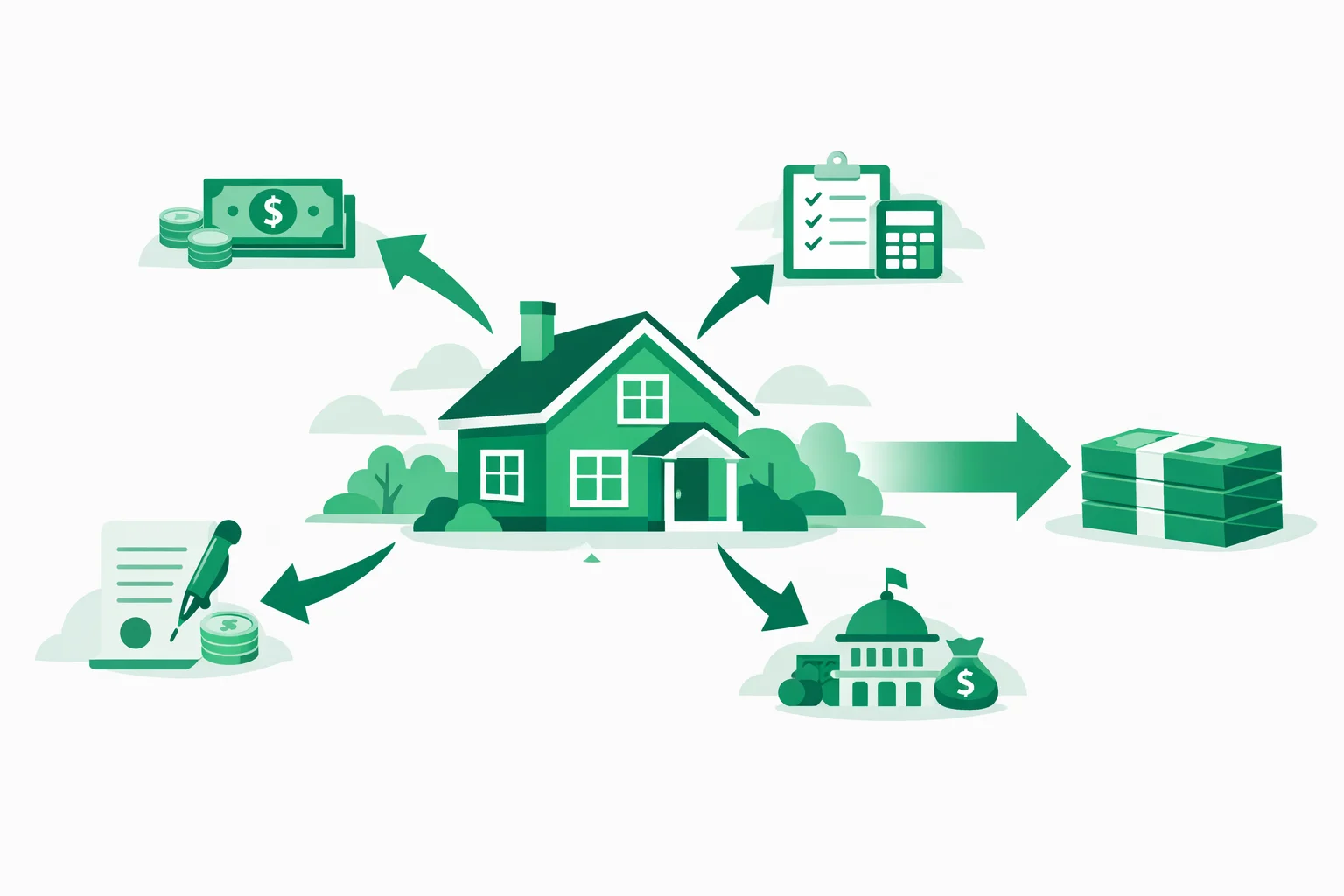
Where Does the 6% Actually Go?
The traditional 6% commission doesn't go to one person. It splits four ways. On a $400,000 sale at 6%, the $24,000 total commission flows like this: $12,000 to the listing brokerage, $12,000 to the buyer's brokerage. Each brokerage then splits with their agent — typically 60/40 to 70/30 in favor of the agent. That means each agent might take home $7,200-$8,400 before taxes and self-employment costs.
Why does this matter to you? Because understanding the split gives you negotiating leverage. A listing agent keeping 70% of a 3% commission on a $400,000 home earns $8,400. Drop that to 2.5% and they earn $7,000 — a $1,400 difference to them but $2,000 in your pocket. Agents on expensive listings often accept lower percentages because the dollar amount is still substantial.
What Does Each Side Really Pay?
Here's a side-by-side breakdown of a $400,000 transaction that most "closing cost guides" bury in paragraphs instead of showing clearly:
| Cost Category | Seller Pays | Buyer Pays |
|---|---|---|
| Agent commissions (5.5%) | $22,000 | $0* |
| Title insurance & search | $1,200-$2,400 | $800-$1,600 |
| Transfer / recording taxes | $800-$4,000 | $200-$600 |
| Escrow / settlement fee | $750-$1,500 | $750-$1,500 |
| Lender origination fees | — | $2,400-$4,000 |
| Appraisal | — | $400-$700 |
| Prepaid insurance & taxes | — | $3,000-$6,000 |
| Inspections | — | $500-$1,200 |
| Typical total | $26,000-$32,000 | $8,000-$16,000 |
*Post-NAR settlement, buyers may pay their own agent separately, shifting $8,000-$12,000 from the seller's column to the buyer's. This depends on the agreement.
Combined, a $400,000 transaction generates $34,000-$48,000 in transaction costs. That's 8.5-12% of the property value — money that doesn't go toward the home itself. If you're using our home sale calculator for the seller's perspective specifically, you'll see how these line items reduce your take-home amount.
The Commission Math Most People Skip
Most sellers hear "6%" and move on. But the difference between a 5% and 6% total commission is not 1% — it's a specific, large dollar amount that depends on your sale price.
On a $350,000 home: 5% = $17,500 and 6% = $21,000. That $3,500 difference is real money. On a $600,000 home the same 1% gap costs $6,000. At $800,000, it's $8,000. The formula:
Commission savings = Sale Price × (Higher Rate − Lower Rate) ÷ 100
Since the 2024 NAR settlement, average total commissions have drifted from 5.5-6% down to 4.5-5.5% in many markets. That shift alone saves sellers $2,000-$6,000 on a median-priced home. But rates vary by market, property type, and negotiation — which is exactly why plugging your real numbers into the calculator above matters more than using national averages.
Closing Cost Reference by Price Range
Closing costs scale with the property price, but not linearly. Some fees are flat (appraisal, inspections), while percentage-based fees grow proportionally. Here's a reference table at three price points — useful for ballpark budgeting before you get a formal estimate from your lender or title company.
| Property Price | Seller Costs (est.) | Buyer Costs (est.) | Combined Total |
|---|---|---|---|
| $250,000 | $16,500-$20,000 | $6,500-$11,000 | $23,000-$31,000 |
| $400,000 | $26,000-$32,000 | $9,500-$16,000 | $35,500-$48,000 |
| $650,000 | $41,000-$50,000 | $15,000-$24,000 | $56,000-$74,000 |
| $1,000,000 | $60,000-$75,000 | $22,000-$35,000 | $82,000-$110,000 |
These ranges assume a 5-5.5% total commission and typical state fees. High-tax states like New York or Connecticut will push seller costs toward the upper end due to transfer taxes alone.
Three Costs That Don't Show Up on the Closing Disclosure
The Closing Disclosure form (which replaced the HUD-1 in 2015) captures most transaction costs, but three categories routinely catch people off guard:
- Mortgage prepayment penalty.Some loans — particularly those originated 2005-2010 — carry prepayment penalties of 1-3% of the remaining balance if you sell within 3-5 years. On a $250,000 balance, that's $2,500-$7,500 you won't see until payoff. Check your loan documents or call your servicer before listing.
- Capital gains tax above the exclusion. If your profit exceeds $250,000 (single) or $500,000 (married filing jointly), the overage is taxed at 15-20%. A home bought for $200,000 and sold for $525,000 generates $325,000 in gains — a single filer would owe taxes on $75,000, roughly $11,250-$15,000 at federal rates.
- Prorated HOA and special assessments.HOA dues get prorated to the closing date, but pending special assessments (a new roof for the building, a community pool repair) might transfer to the buyer or stay with the seller depending on your state's rules and the contract language. A $5,000 special assessment can surprise either side.
Should You Ask for Seller Concessions?
Seller concessions — where the seller credits the buyer money to cover closing costs — sound like free money, but the math is more nuanced. Here's a decision framework:
Ask for concessions when:you're cash-constrained and need to preserve down payment funds. A $10,000 seller credit on a $350,000 home means you bring $10,000 less to closing. The tradeoff? You're financing those costs into the mortgage. At 6.5% over 30 years, that $10,000 concession actually costs $22,740 in total payments. Still worth it if the alternative is not buying at all.
Skip concessions when: you have the cash and the market is competitive. Sellers prefer clean offers. An offer at $345,000 with no concessions often beats $350,000 with $10,000 in seller credits — the seller nets the same, but the concession offer adds appraisal risk and complexity. Use our closing costs calculator to see exactly what you'd save and whether it's worth the negotiation friction.
How the NAR Settlement Changed Commission Negotiations
Before August 2024, the listing agent set the buyer's agent commission in the MLS listing. Sellers paid both sides without much discussion — the 5-6% combined rate was treated as an industry standard. The NAR settlement changed two things: listing agents can no longer advertise a co-op commission on the MLS, and buyers must sign a written agreement with their agent specifying compensation before touring homes.
What's this meant in practice? The listing-side commission has stayed roughly the same (2.5-3%), but buyer's agent compensation now varies more. Some buyers negotiate 2% flat fees. Others pay hourly or a fixed dollar amount. The net effect so far: total transaction commissions dropped from an average of 5.49% in 2023 to roughly 5.0-5.2% in early 2026, according to industry surveys. On a $400,000 sale, that 0.3-0.5% drop saves the transaction $1,200-$2,000.
Walking Through a $425,000 Sale Start to Finish
Let's trace every dollar on a real-world sale. The seller bought the home for $310,000 six years ago and owes $235,000 on the mortgage.
- Sale price: $425,000
- Mortgage payoff: $235,000
- Gross equity: $190,000
- Listing agent at 3%: $12,750
- Buyer's agent at 2.5%: $10,625
- Title & escrow fees: $2,800
- Transfer tax (0.5%): $2,125
- Prorated property taxes: $1,900
- Repair credits from inspection: $4,500
- Total deductions: $34,700
- Net proceeds: $155,300
That $155,300 is 36.5% of the sale price and 81.7% of the gross equity. The seller lost $34,700 — about 8.2% of the sale price — to transaction friction. If they're rolling these proceeds into a new home, our down payment calculator can show how far that $155K stretches as a down payment on the next purchase. If they're considering a rental property instead, our real estate investment calculator will model the ROI, cash flow, and cap rate before they commit.
When These Numbers Won't Match Reality
This calculator uses national averages and percentage-based estimates for most line items. Your actual closing costs will differ — sometimes significantly — in these situations:
- High transfer-tax states. New York City charges 1.4-2.625% in combined transfer taxes depending on price. Connecticut adds 0.75-2.25%. These alone can swing seller costs by $5,000-$15,000 compared to states like Wyoming or Idaho where transfer taxes are negligible.
- Attorney-required closings.About 22 states require a real estate attorney at closing, adding $1,500-$3,000 to either side's costs. Check if your state is on the list before budgeting.
- New construction.Builder contracts often shift closing cost responsibility — the builder may cover title insurance but charge transfer taxes to the buyer, or vice versa. Standard percentage estimates don't apply cleanly.
- Short sales or foreclosures. If the seller owes more than the property is worth, standard net-proceeds calculations are meaningless. The lender controls the transaction terms, and deficiency judgments vary by state.
For the most accurate numbers, request a Closing Disclosure from your lender or title company at least three business days before closing. That federally mandated document shows every actual fee to the penny.